
Is It Worth Fixing an Old Garage Door? Here’s How to Decide Fast
Is it worth fixing an old garage door depends on a few key factors — and in most cases, the answer comes down to age, repair costs, and how often it breaks down.
Quick answer:
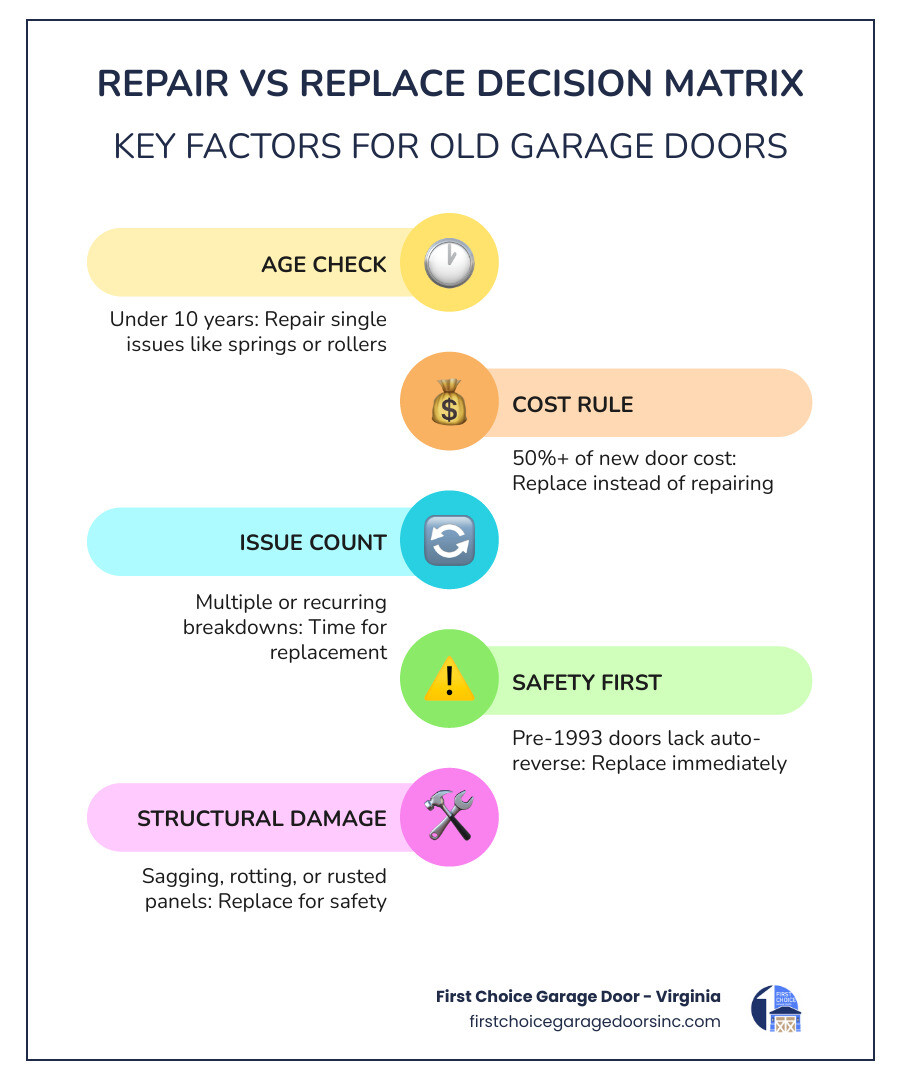
| Situation | Best Action |
|---|---|
| Door is under 10 years old, single issue (spring, roller, cable) | Repair |
| Door is 10–15 years old, isolated problem, good structure | Likely repair |
| Door is 15–20+ years old, multiple issues, or repair cost is 50%+ of a new door | Replace |
| Door was made before 1993 (no auto-reverse) | Replace for safety |
| Panels are sagging, rotting, or heavily rusted | Replace |
The 50% rule is the simplest guide: if what you’d spend on repairs equals half or more of what a new door costs, replacement almost always makes more financial sense.
Here in Northern Virginia, garage doors take real punishment — hot, humid summers, cold winters, and everything in between. That wear adds up faster than most homeowners expect.
A well-maintained garage door can last 15 to 30 years, but the springs, rollers, and opener often give out sooner. And an aging door isn’t just an inconvenience — it can be a genuine safety risk.
This guide walks you through every factor that matters, so you can make a confident decision about your garage door in 2026.
Is it worth fixing an old garage door in Northern Virginia?
When we visit homes in Manassas or across Northern Virginia, we often see homeowners struggling with the same dilemma: do I keep patching up this old door, or is it time for a fresh start? Determining Choosing Between Garage Door Repair Or Replacement requires a look at the long-term math.
The “50% Rule” is our gold standard. If a technician gives you a quote for repairs that exceeds 50% of the price of a brand-new, installed door, we almost always recommend replacement. Why? Because an old door that needs a major fix today is likely to need another one tomorrow. You might spend hundreds on a new motor this year, only to have the springs snap or the panels buckle six months later.
Beyond the immediate price tag, we have to look at the system’s age. If your door is over 15 years old, it has likely reached the end of its “reliable” life. At this stage, the metal is fatigued, the tracks may be slightly out of alignment, and the overall structural integrity is declining.
Is it worth fixing an old garage door when parts are obsolete?
One of the biggest hurdles we face with older doors is hardware sourcing. As we move through 2026, many manufacturers have discontinued support for models built in the early 2000s or late 90s.
If your door uses a specific type of bracket, hinge, or panel design that is no longer in production, a simple repair can become a nightmare. We’ve seen cases where Concerns With Having An Older Garage Door include the inability to find matching panels after a minor accident. When parts become obsolete, you aren’t just paying for a repair; you’re paying for a “workaround” that may not be as safe or effective as the original design.
Evaluating the 15-to-30-year lifespan
While some high-end steel doors can technically last 30 years, that number is often a best-case scenario. In Northern Virginia, our climate plays a huge role. The constant cycle of freezing winters and humid summers causes materials to expand and contract.
Usage frequency is another factor. The average garage door opens and closes 3 to 5 times a day, which equals about 1,000 to 1,500 cycles per year. Most springs are only rated for 10,000 cycles. By the time a door hits the 15-year mark, it has likely gone through its second or third set of springs and its original opener is on its last legs. Knowing When To Repair Vs Replace Your Garage Door means acknowledging that after 20 years, every component is essentially living on borrowed time.
Recognizing When Your Garage Door is Beyond Repair
Sometimes, the door itself tells you it’s finished. We look for “red flag” symptoms that indicate the door is no longer structurally sound. If you see visible sagging when the door is in the open position, or if the bottom panel is starting to “smile” (curve upward at the corners), the internal reinforcement has failed.
For our neighbors with older wood doors, rot is the primary enemy. Once moisture gets into the core of a wood panel, it’s only a matter of time before it becomes too heavy for the opener to lift safely. For steel doors, deep-seated rust at the bottom—where salt and slush sit during Virginia winters—is a sign that the metal is thinning and could fail.
| Feature | Minor Repair (Keep the Door) | Major Failure (Replace the Door) |
|---|---|---|
| Panels | One minor dent or scratch | Multiple warped, rotted, or rusted panels |
| Springs | Single broken spring | Repeated failures or rusted torsion tube |
| Alignment | Door slightly off-track | Tracks are bent or pulling away from the wall |
| Opening | Occasional hesitation | Constant grinding, shaking, or refusal to move |
If you notice these Signs You Need A Garage Door Replacement, it’s a matter of safety, not just aesthetics.
Identifying chronic breakdown patterns
Are you on a first-name basis with your garage door technician? If we’re coming out once or twice a year to “tweak” things, you’re likely caught in a cycle of mechanical fatigue. Frequent service calls are a clear indicator of Knowing When You Need A Garage Door Replacement. Cumulative repair costs over three years can often equal the price of a new door that comes with a fresh warranty and ten years of worry-free operation.
The impact of sagging and warping
When a door sags or warps, it puts immense strain on the entire system. A warped door doesn’t sit flush in the tracks, which forces the motor to work twice as hard to pull it up. This leads to premature motor failure and can even cause the tracks to pull out of the drywall. You should Do You Need A Garage Door Replacement Check For These Signs To Find Out if your door looks crooked or makes a loud “popping” sound as it transitions through the curve of the track.
Safety and Technology: Why Modern Doors Outperform the Classics
Safety is the most compelling reason to stop asking is it worth fixing an old garage door and start looking at new ones. Any door manufactured before 1993 lacks the modern safety sensors (photo-eyes) and automatic reversal systems required by federal law.
These older doors are heavy, “dumb” machines. If a child or pet is under the door when it closes, it may not stop. Modern systems use infrared beams and force-detection technology to stop and reverse the door instantly if an obstruction is detected. If your door doesn’t have these features, When A Garage Door Replacement Should Be Done is right now.
Upgrading for enhanced home security
Older garage door openers used “fixed codes” that were incredibly easy for tech-savvy burglars to copy. Modern openers use rolling-code technology, which changes the access code every single time the remote is pressed.
Furthermore, 2026 technology allows for smart connectivity. You can check if your door is closed from your smartphone while you’re at work in Manassas or on vacation. New units also feature battery backups—a lifesaver during Northern Virginia’s summer thunderstorms when the power goes out. These are the benefits you realize When Is It Time To Have A Garage Door Replacement.
Reducing noise and improving operation
If your current door sounds like a freight train coming through your living room, it’s likely because of outdated hardware. Older systems relied on chain drives and steel rollers that clattered and vibrated.
Modern replacements often feature belt drives (made of reinforced rubber) and nylon rollers with ball bearings. The result is a door that whispers open. When Choosing Between A Garage Door Repair Or Replacement, consider the peace and quiet a new system brings to your home, especially if you have a bedroom located above the garage.
Maximizing Energy Efficiency and Curb Appeal
Your garage door is likely the largest uninsulated surface in your home. An old, thin door allows heat to escape in the winter and turns your garage into an oven in the summer. Modern doors come with high R-values, which measure thermal resistance.
Upgrading to a polyurethane-insulated door can save you $20 to $40 a month on energy bills. This is particularly important for attached garages, where the temperature in the garage directly affects the room next to it. We often explain Why Fall Is The Time To Get A Garage Door Replacement—it prepares your home for the cold Virginia winter ahead.
Boosting resale value in Northern Virginia
In real estate, first impressions are everything. Because the garage door can occupy up to 30% of your home’s front facade, it has a massive impact on “curb appeal.”
According to home improvement ROI reports, a new garage door is consistently one of the best investments you can make, often returning 90% to 100% (or more) of its cost at the time of sale. If you’re planning to list your home, Why Get A Garage Door Replacement Ahead Of Winter is a smart move to attract buyers who don’t want to inherit a “fixer-upper” garage.
The benefits of modern insulation
Modern insulation isn’t just about temperature; it’s about strength. Polyurethane foam is injected between the steel skins, bonding to them and creating a “sandwich” that is incredibly rigid and dent-resistant. New weatherstripping and bottom seals also keep out pests, dust, and driving rain. Even for businesses, Signs You Should Replace Your Commercial Garage Door often center on these efficiency gains.
Frequently Asked Questions About Aging Garage Doors
How many years should a garage door last?
On average, you can expect 15 to 30 years. However, the hardware—like the springs and rollers—usually needs replacing every 7 to 10 years. If you perform regular maintenance, such as lubricating moving parts twice a year and checking the balance, you can push your door toward that 30-year mark. Without maintenance, a door can start failing in as little as 12 years.
Is it worth fixing an old garage door with structural damage?
Generally, no. If the panels are buckled, sagging, or rotted, the door is no longer safe. Fixing structural damage often requires replacing multiple panels, and for an old door, the cost of those panels plus labor usually gets you very close to the price of a brand-new, modern door with a full warranty.
When should I seek professional advice?
You should call a professional if the door feels heavy, makes new or unusual noises, or if you see any frayed cables or broken springs. Never attempt to fix garage door springs yourself; they are under extreme tension and can cause serious injury. A reputable company will provide an honest assessment and tell you if a repair is a safe, long-term solution or just a temporary bandage.
Conclusion
At First Choice Garage Doors, we’ve seen it all—from doors that just need a quick tune-up to “ancient” systems that are held together by luck and old paint. Our priority is always your safety and the long-term value of your Northern Virginia home. Whether you’re in Manassas or the surrounding areas, we provide expert guidance to help you decide when it’s time to repair and when it’s time to upgrade.
Choosing a new door isn’t just a purchase; it’s an investment in your home’s security, efficiency, and beauty. For More info about garage door repair services or to schedule a professional inspection, reach out to our team today. We’re here to ensure your garage door is a feature of your home you can rely on for years to come.